
South San Francisco Directory Coverage
South San Francisco people directories range from live agency listings to old sources preserved by the library. The right choice depends on the link being checked. A department number belongs in the city phone directory. A teacher belongs in an education directory. An owner may appear in a parcel roll or deed index, while a former resident may be easier to place in a city directory, yearbook, newspaper, or burial register.
| Listing Source | People or Names Included | Responsible Keeper | How to Use It |
|---|---|---|---|
| City phone directory | Departments and divisions | City of South San Francisco | Free online table |
| SSFUSD directory | District and school staff | South San Francisco Unified | Name and location filters |
| SMCCCD directory | College faculty and staff | San Mateo County CCD | Online personnel directory |
| RecorderWorks | Recorded-document parties | San Mateo Clerk-Recorder | Index from 1985; images at office |
| Property portal | Current parcel owners | San Mateo Assessor and GIS | Owner, address, and APN search |
| City directories and yearbooks | Past residents and students | SSF Library History Collection | Digitized and staff-assisted |
| License indexes | Licensees and business names | State, county, and city agencies | Several online searches |
| Catholic burial search | Interments at seven cemeteries | Catholic Cemeteries | Online; updated weekly |
No row is a universal roster of South San Francisco residents. Official people directories are narrow by design. They show a public role, recorded transaction, parcel interest, school connection, or historical appearance. The voter roll is not an open browse directory, and the city does not publish a single searchable list of all employees.
South San Francisco Government Directories
The South San Francisco phone directory is organized by department and division, not employee name. It points to the City Clerk, City Council, Building, Planning, Finance, Fire, Library, Police Records, Investigations, Evidence, Public Works, Code Enforcement, Engineering, and Water Quality. This works well when the office function is known but the staff member is not. City boards and commissions form a separate civic directory of public bodies, members, meeting sites, and vacancies.
| Department | Main city office or service |
|---|---|
| Division | Unit such as Police Records or Planning |
| Phone | Direct division or office number |
| Individual names | Not supplied as one citywide search |
View the source for the city directory screenshot.
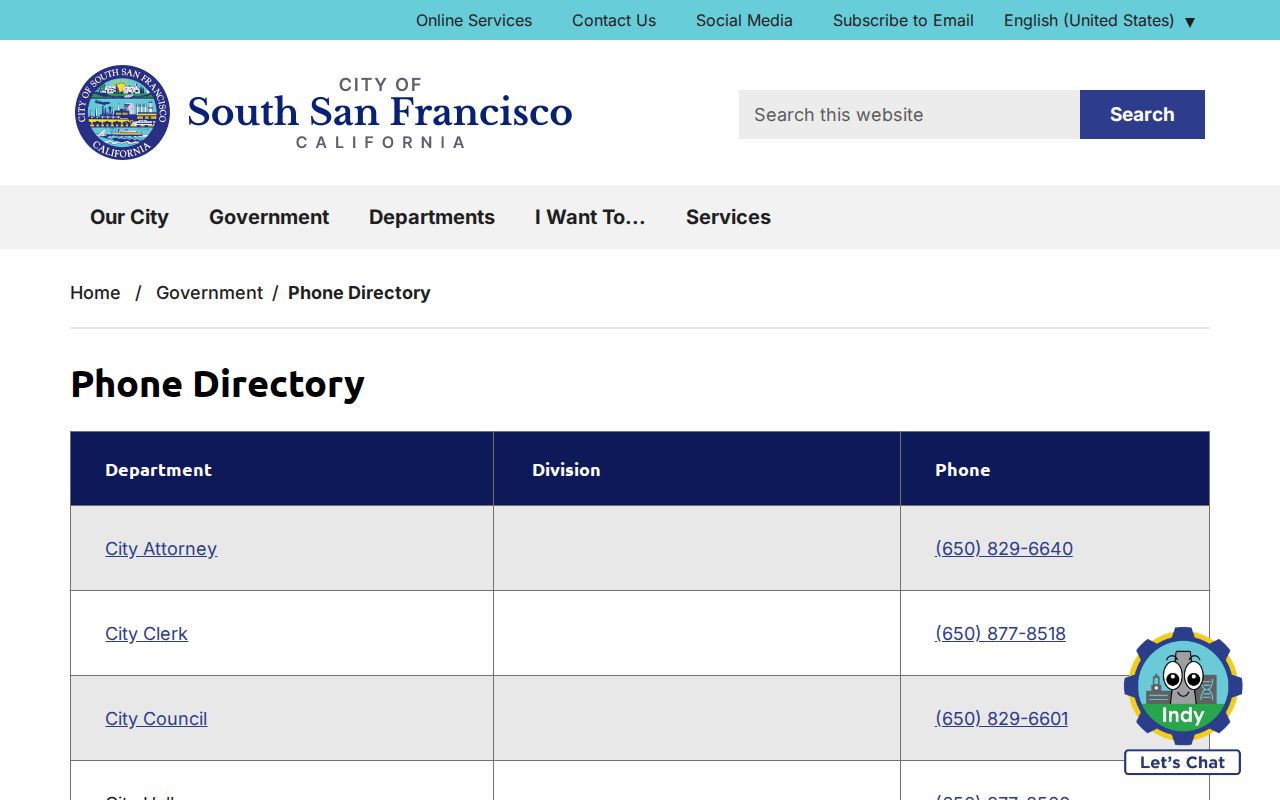
The department and division layout helps a caller reach the proper desk without assuming that a full staff roster exists.
California's Personnel Office Directory, or CPOD, is also narrower than its name suggests. It lists state personnel-office contacts rather than every worker. If a city name is absent, call the department line first. The City Clerk can explain whether an existing staff record is available. Detailed request procedure belongs with South San Francisco public records access.
Open the state source shown in the California directory screenshot.
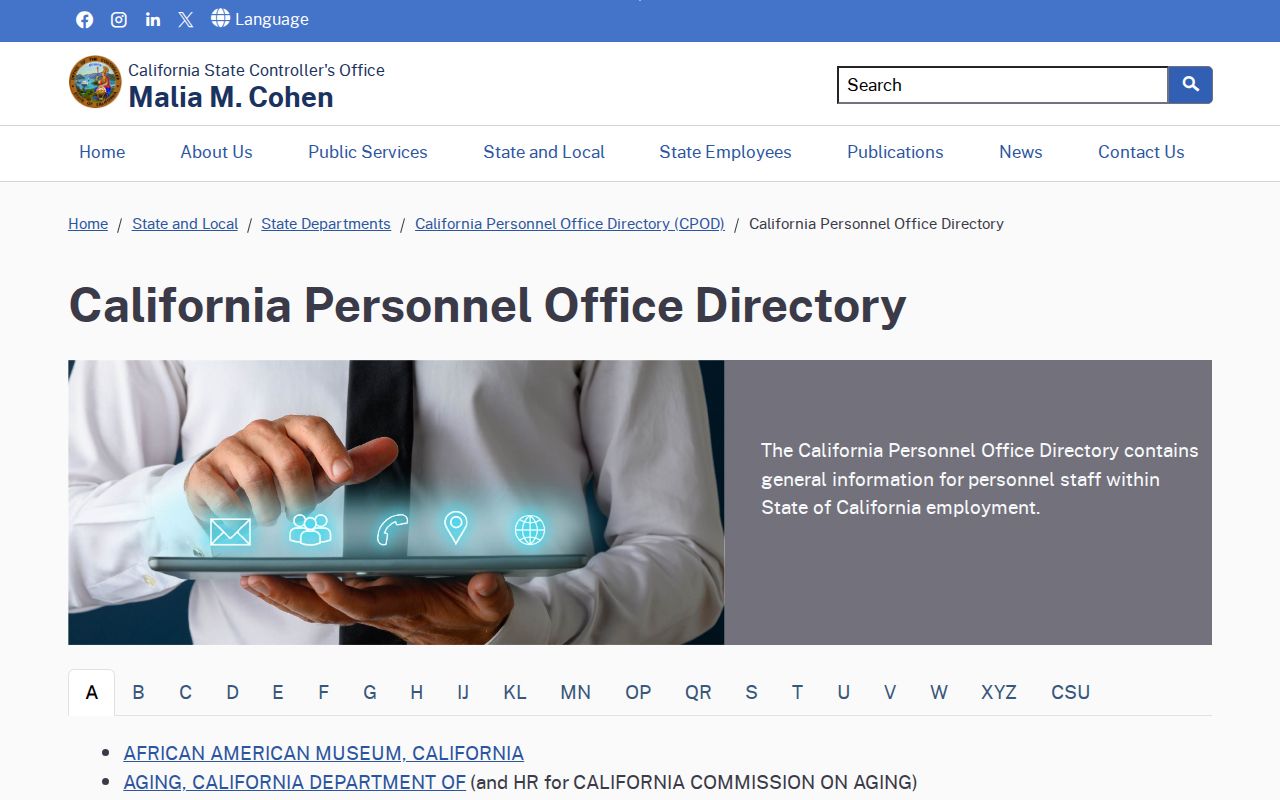
Its office-based scope shows why each directory title should be read before treating a result as a person-level listing.
South San Francisco School Directories
The SSFUSD District Directory is a true person search. At inspection it held 246 entries, displayed 24 per page, and accepted first name, last name, or location. Its location menu covers district offices, adult education, district-wide programs, special education, the bond program, schools, and service units. Results show a name, title, and email.
| Search Control | Input | Required | Use |
|---|---|---|---|
| First Name | Text | No | Filters by given name |
| Last Name | Text | No | Filters by family name |
| Location | Dropdown | No | Limits results to a school or unit |
| Pagination | Page control | Not applicable | Moves through result batches |
Compare those fields with the live SSFUSD directory shown here.
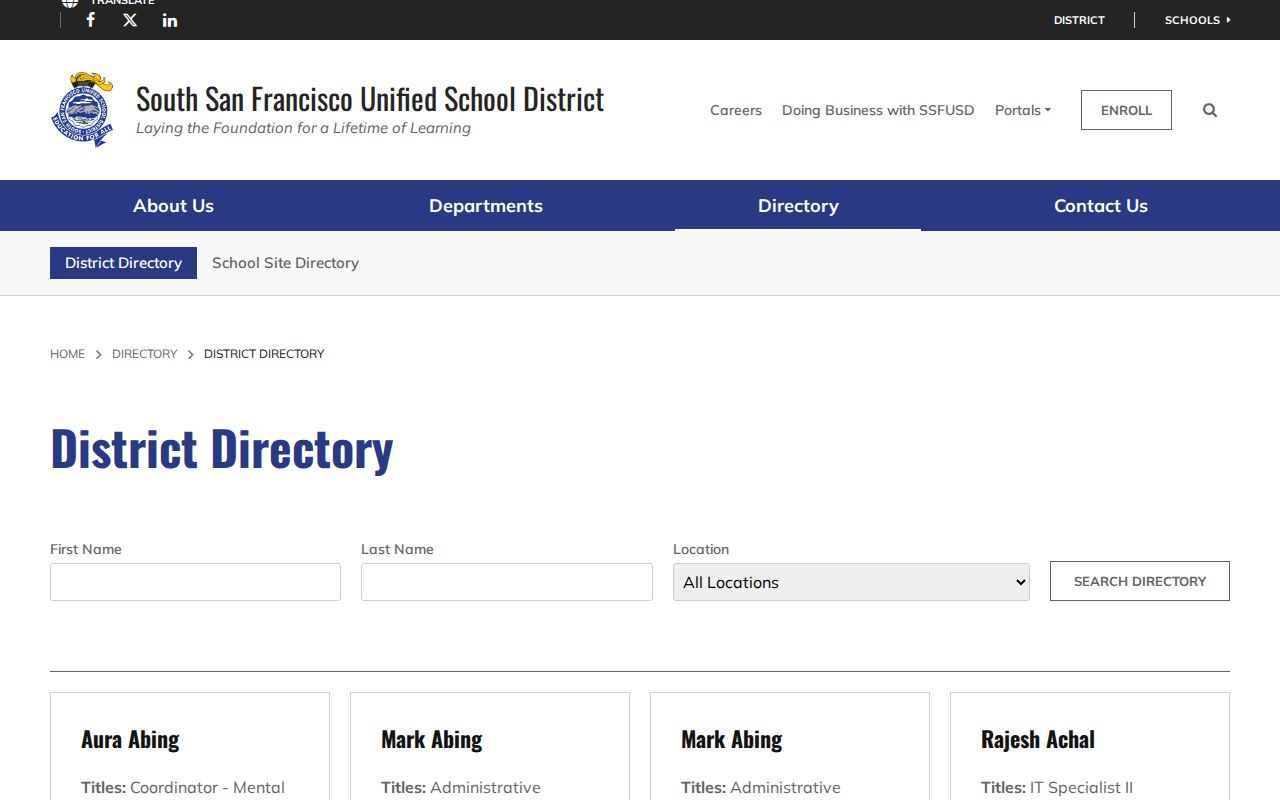
The location filter helps when several staff members share a surname or a role appears at more than one campus.
Higher-education names may appear in the SMCCCD faculty and staff directory. It covers Skyline College in nearby San Bruno, College of San Mateo, Cañada College, and the District Office. Results may connect a name with a campus, title, unit, email, phone, and room. Catalog faculty lists may add appointment year, discipline, and degrees. Because SSFUSD service reaches beyond city limits, a school hit alone does not prove city residence.
The SMCCCD source screenshot shows its district-wide entry point.
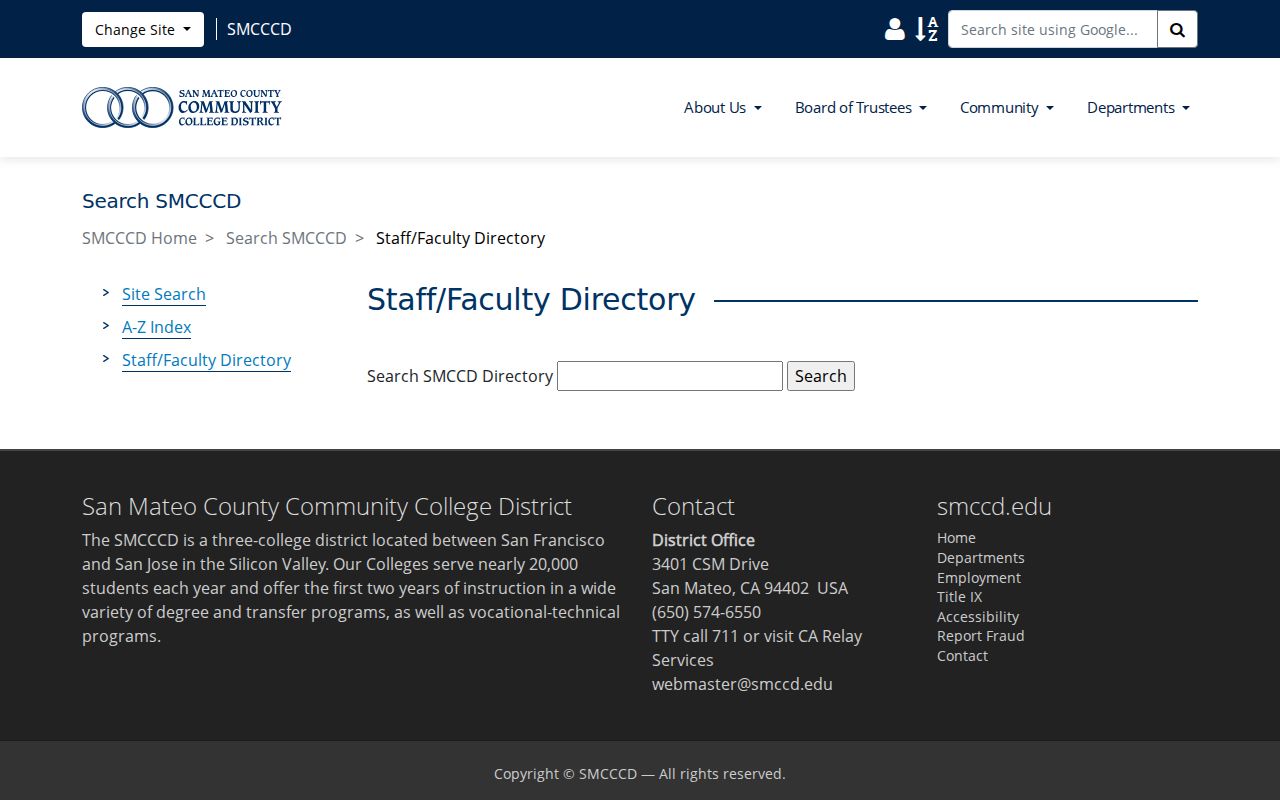
Use the campus or unit as context, then confirm the person through the institution's own contact channel.
South San Francisco Records Directories
Some public indexes act like people directories even though they organize records. RecorderWorks searches grantors and grantees, meaning parties who give or receive an interest in a document. Enter last name followed by first name, choose all parties, grantor, or grantee, allow a partial match if needed, and narrow by date. Coverage begins in 1985. Results show document types and recording dates, but images must be viewed or ordered through the Clerk-Recorder.
The MIDX court index is a limited party directory for nonconfidential cases. It accepts person and business names, while the courthouse and Odyssey may offer more detail for eligible files. These indexes show an official event, not a current phone or address. Dates, document types, case numbers, and other parties help distinguish people with the same name.
Use official directory details for lawful personal research and civic review. Never use them to stalk, harass, threaten, or harm another person.
South San Francisco Owner Directories
The San Mateo County Property Information Portal works as a current owner directory. It searches by owner, street address, or assessor parcel number. An assessor parcel number, or APN, is the county's nine-digit land identifier. Results can include two owners, mailing and property addresses, legal description, values, exemptions, sale date, document number, neighborhood, year built, and building facts. The property location is also called the situs address.
The mailing address may be the stronger directory field. It can identify a nonresident owner, trust, estate, or related contact. A result's document number can then be checked in RecorderWorks. City eTRAKiT adds an address and parcel view with Owner Info, Land Use, Building, Legal Description, and Inspections. Permit records may list public applicant, contractor, owner, or project-contact names.
Note: Search a nine-digit APN without dashes when a county or recorder tool rejects the formatted parcel number.
South San Francisco Business Directories
Business and professional people directories are split among state, county, and city systems. The California DCA License Search accepts first name, last name, license number, business name, and license type. A result may state whether a license is current, expired, suspended, or revoked. Physicians, contractors, real estate licensees, and attorneys also have their own board directories.
The Secretary of State business search covers corporations, limited liability companies, and limited partnerships. San Mateo County fictitious business name records can tie a trade name to its listed owner. South San Francisco eTRAKiT accepts a company or license number and offers License Info, Site Info, Contacts, fees, inspections, conditions, and chronology. Its contractor directory searches by registration number or company.
The South San Francisco Chamber can supply local context, but no confirmed public member roster was found. Treat it as a contact, not a full directory. Official agency indexes are stronger for checking a seller, confirming a credential, or matching a company name to a filing.
Historical South San Francisco Directories
Historical South San Francisco people directories survive in several series. The official city page confirms city directories for 1907, 1929, 1938, and 1940. The Library History Collection also holds phone books, maps, ledgers, photos, scrapbooks, pamphlets, oral histories, newspapers, and clippings. Exact phone-book years and reverse, or address-to-name, holdings should be confirmed with staff.
- City directory
- A dated resident and business listing, often arranged by surname.
- Reverse directory
- An address-first listing used to identify the occupant recorded at a street location.
- Finding aid
- A collection description that helps staff locate boxes, volumes, and date ranges.
| Historical Series | Confirmed Span | Names It May Supply | Access |
|---|---|---|---|
| City directories | 1907, 1929, 1938, 1940 | Residents and businesses | Digitized and staff-assisted |
| Yearbooks | 1917-2016, with gaps | Students, teachers, clubs | Staff-assisted |
| City Ledgers | 1908-1966 | Municipal names | Finding aid and staff help |
| Scrapbooks | 1875-1979 | Civic and family mentions | Finding aid and staff help |
| Enterprise newspapers | 1895-1938; 1972-1979 | News, ads, notices, obituaries | Online newspaper archive |
A name may change spelling across editions, and an address may use Baden or a former neighborhood label. A city directory can establish one year's address. A phone book may add a number. Newspapers can connect relatives, civic groups, firms, and legal notices. Maps and deeds help translate the entry into a modern parcel.
South San Francisco Archive Directory
The South San Francisco ArchivesSpace resource list is a finding-aid directory. A finding aid describes a collection and its dates, scope, and organization; it does not mean every item is scanned. Searchers can browse collections, digital materials, subjects, names, record groups, and repositories, then filter by year or subject.
The ArchivesSpace screenshot shows the public collection search.
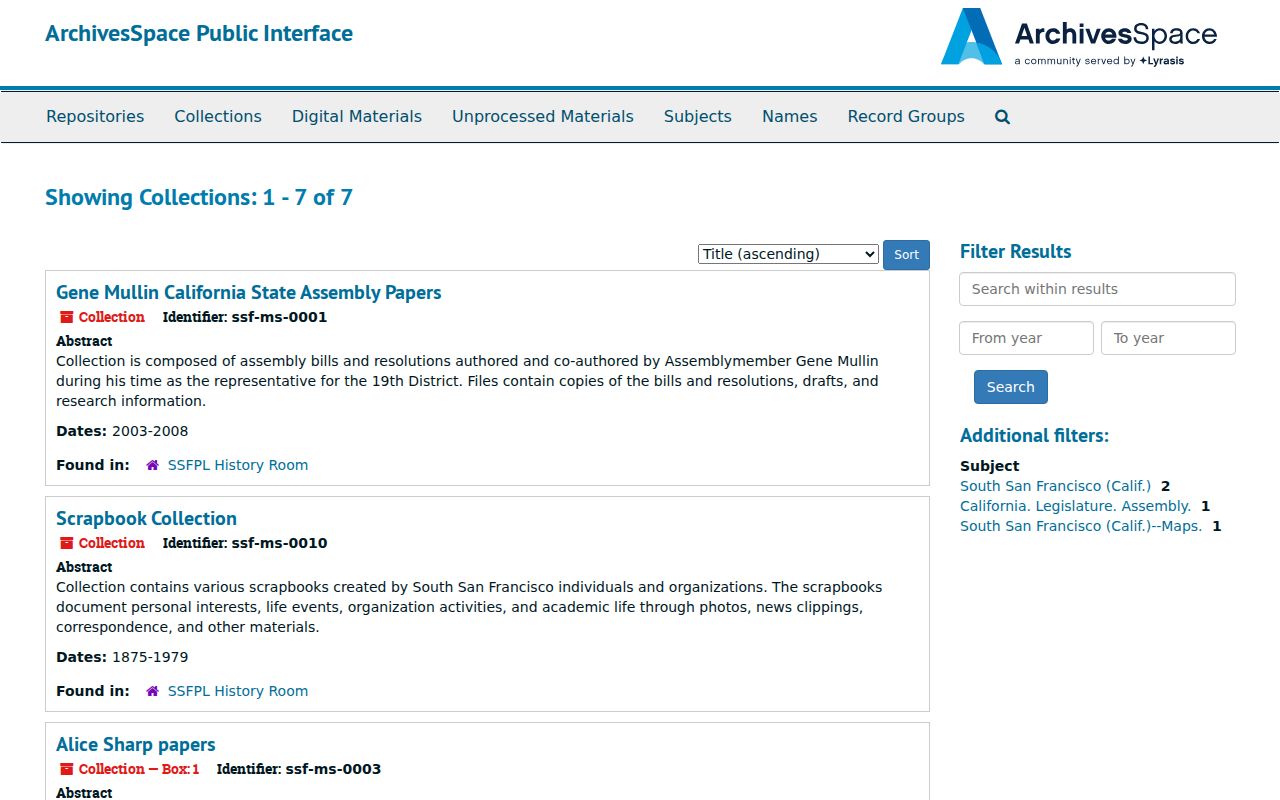
The filters narrow collections, not residents, so pair a surname with a year, address, school, civic group, or business.
The History Room is closed to casual browsing. Email history@ssf.net with name variants, likely years, addresses, and school links. Staff can select useful directories or boxes and coordinate access. Grand Library is at 306 Walnut Avenue; published numbers are (650) 877-8530 for the branch and (650) 829-3860 for the History Room.
South San Francisco Yearbook Directories
The Yearbook Collection spans 1917 through 2016, holds more than 200 volumes, and has some missing years. It is one of the strongest people directories for reconnecting with classmates or tracing family names. A volume may show a student, teacher, club, team, activity, nickname, or graduation-era image. School affiliation also helps separate people who share a common name.
Start with a school and narrow year range. Search maiden-name options and spelling variants. If a volume is missing, try school events and class mentions in Enterprise-Journal issues, historical society yearbooks, or open district sources. The South San Francisco Historical Society also keeps school yearbooks, newspapers, oral histories, maps, photos, and a photo database.
South San Francisco Burial Directories
No official municipal cemetery portal was found. Many South San Francisco families used nearby Colma and Catholic systems. The Catholic Cemeteries burial search covers interments at seven cemeteries and says records are updated weekly. Holy Cross Cemetery history begins in 1887.
Burial results work best beside obituary and newspaper directories. The San Mateo Daily Journal has an obituary archive. County library genealogy tools include HeritageHub for eligible users, while Enterprise newspaper runs hold older death notices, funeral reports, and family references. A burial entry may provide the cemetery needed to locate more family context.
Geography shapes these directories. Downtown and Grand Avenue yield older civic and business entries. East of 101 and Lindenville lean toward industrial and company records. El Camino Real and Westborough more often connect parcel, school, and residential listings. Keep the key jurisdiction in view: South San Francisco is in San Mateo County, not the City and County of San Francisco.