
How South San Francisco Records Open
South San Francisco public records do not share one search box or one access rule. Some record sets have a free name or address index. Others offer only a request form, office terminal, or certified-copy process. A custodian is the agency that creates or keeps a record. That office decides the request under the law that applies to the record, including any privacy exemption.
| Record Set | Keeper | Online Route | Practical Access |
|---|---|---|---|
| City council, administrative, and department files | South San Francisco City Clerk or department | GovQA archive and request center | Inspect or request; anonymous portal submission is available |
| Deeds, liens, maps, and recorded notices | San Mateo County Clerk-Recorder | RecorderWorks index from 1985 | Index online; images viewed or copied through the office |
| Parcels and assessment roll | San Mateo County Assessor and GIS | Property Information Portal | Owner, address, APN, value, and sale fields online |
| Superior Court cases | San Mateo Superior Court | MIDX and Odyssey | Index or permitted documents online; clerk terminals and copies fill gaps |
| Birth, death, marriage, and divorce | County Clerk-Recorder, CDPH, or Superior Court | Forms and request pages | Eligibility and copy type vary by event |
| Permits and city licenses | South San Francisco Permit Center | eTRAKiT | Search by permit, address, parcel, company, or license number |
| Police and custody material | City Police, County Sheriff, or CDCR | Citizen RIMS and custody locators | Published data plus agency-specific requests |
Open does not always mean downloadable. Sealed cases, juvenile and adoption files, confidential court matters, protected addresses, and parts of vital records remain closed or limited. Voter information also follows its own restricted-use rules. The South San Francisco voter records resource treats that system separately rather than presenting it as a public name directory.
South San Francisco Records Geography
South San Francisco is in San Mateo County. It is not part of the City and County of San Francisco. This small point controls where many useful records live. Property documents, county vital certificates, Superior Court cases, Sheriff custody data, and assessments usually lead to San Mateo County offices in Redwood City or San Mateo. Municipal permits, council files, and city police records stay with South San Francisco.
State agencies enter the chain when a search crosses county lines or involves a statewide program. California keeps statewide vital files, professional licenses, business entities, state custody data, and address-confidentiality services. Federal court and custody records use federal systems. The right route depends on who made the record, not merely on a place name printed in it.
Jurisdiction check. Confirm that the event occurred in South San Francisco before using San Mateo County systems; a San Francisco address belongs to a different county.
RecorderWorks Deed Index
The RecorderWorks grantor-grantee index covers San Mateo County recorded documents from 1985 forward. A grantor transfers an interest, while a grantee receives it. Users can narrow a party-name search by either role, allow a partial match, and set dates. Separate modes accept a document number, document type, parcel, recording date, or book and page.
| Search Field | Input | Format or Use |
|---|---|---|
| Party role | All, Grantor, or Grantee | Limits how the name appears in the recorded transaction |
| Person or business | Name text | Enter a person as LAST FIRST; partial matching is optional |
| Date range | Start and end dates | Uses MM/DD/YYYY |
| Document number | Year and sequence | Uses a four-digit year plus document sequence |
| Map or parcel | APN | Enter the nine-digit parcel number without dashes |
| Document type | Dropdown | Pairs a deed, lien, judgment, or other type with dates |
An index entry identifies the party, document type, recording date, document number, and sometimes parcel or book/page reference. It is not the recorded image. San Mateo County withholds images online for privacy. View them without charge at the Clerk-Recorder office, or order copies by mail with the party names, type, date, and recording number. Regular copies cost $5 for the first page and $1 for each added page; certification is separate.
- Index
- A finding list that points to a filed record but is not the full record.
- Image
- The scanned page or pages of the document itself.
- Certified copy
- A copy carrying the custodian's formal certification for an official use.
- Exemption
- A law-based reason an agency may withhold all or part of a record.
South San Francisco Property Records
The San Mateo County Property Information Portal connects an address, owner, or assessor parcel number to the active assessment record. APN means assessor parcel number, the county's nine-digit parcel key. Results may show owner and second owner, the owner's mailing address, the situs address where the parcel sits, values, exemption data, record date, document number, last sale details, district, neighborhood, year built, and building facts.
The mailing and situs fields serve different purposes. A situs address names the land. The owner's mailing address shows where the tax or assessment notice goes, which may be elsewhere. A document number from the parcel report can then be entered in RecorderWorks. That link is precise: parcel report to document number, then deed index, then an office copy if the recorded image is needed.
The Assessor handles about 237,000 assessments, 50,000 transfer documents, 24,000 building permits, 143,000 exemptions, and 10,000 business property statements each year. Those figures help explain why the portal and recorded-document index are separate systems. County GIS data are exported daily, while the Recorder remains the source for the filed instrument.
Note: Remove dashes and spaces from a nine-digit APN when a parcel or RecorderWorks search rejects the formatted number.
South San Francisco Court Access
San Mateo Superior Court divides remote access between MIDX and Odyssey. MIDX searches appeals, civil, criminal, family law, probate, and small-claims indexes by case number, person, business, or a filing-date range. A person search needs at least two characters in both first and last names and permits a wildcard. A filing-date search is limited to five calendar days.
The MIDX case index is not the official court file. Odyssey may display a register of actions, meaning the dated list of events filed in a case, and allowed documents for non-confidential matters. Public lobby computers add a vital fallback: court Records Management says terminals show filed documents and court dates for cases filed after 2000. Mail requests and the clerk counter remain options when remote access is narrow.
Copies cost $0.50 per side. Certification of a paper, record, or proceeding is $40, while a search taking more than ten minutes costs $15. Adoption, juvenile, mental-health, sealed, confidential, and some paternity records do not appear online. Full divorce decrees come from Superior Court; the state vital-record office issues only a certificate of record.
South San Francisco Vital Records
For a birth, death, or marriage in South San Francisco, the San Mateo County Clerk-Recorder is the local copy source. The California Department of Public Health Vital Records office handles statewide requests, amendments, and other state processes. County fees are $34 for a birth certificate, $26 for a death certificate, and $19 for a marriage certificate. CDPH fees effective January 1, 2026 are $31, $26, and $19 for those same records; a state dissolution certificate costs $18.
California Health and Safety Code section 103526 separates an authorized certified copy from an informational copy. An authorized copy requires an eligible requester and a notarized sworn statement or approved electronic verification. An informational copy is available for many events but is marked as not valid for identity. A failed CDPH search does not trigger a refund; the agency keeps the fee as a search charge and issues a Certificate of No Public Record.
Marriage certificates must be sought from the county where the license was purchased. San Mateo accepts certificate orders in person, by mail, and online through VitalChek. Marriage files before 1966 require advance notice because they are stored off-site. CDPH cannot supply certified marriage copies for 2000 through 2007, so those requests go to the county recorder. These limits make the event place and year essential before paying a fee.
South San Francisco Records Custodians
Three offices cover most city, county, and court requests. Call first when a record is old, stored off-site, or likely to have copy restrictions. A specific document number, case number, address, department, and date range can save a paid search.
South San Francisco City Clerk
400 Grand Avenue
South San Francisco, CA 94080
(650) 877-8518
San Mateo County Clerk-Recorder
555 County Center
Redwood City, CA 94063
(650) 363-4500
RecorderWorks and county copy services
San Mateo Superior Court
Countywide court records and copy access
Clerk and public terminals
Court Records Management
City Clerk materials include legislative files, ordinances, resolutions, minutes, board and commission records, campaign filings, and department records routed through the city system. The county office combines recorded documents with vital records, fictitious business names, and other clerk functions. The court remains its own custodian even when a decree is later mentioned in a recorder index.
South San Francisco Permit Records
South San Francisco eTRAKiT turns a street address or permit number into recent building and development detail. Permit results can include Permit Info, Site Info, Contacts, Fees, Inspections, Chronology, Conditions, and Reviews. Plans are also available for inspection during regular working hours at the City Hall Annex, 315 Maple Avenue, when the web record is not enough.
The official eTRAKiT permit search is shown below with its Search By, operator, and value controls.
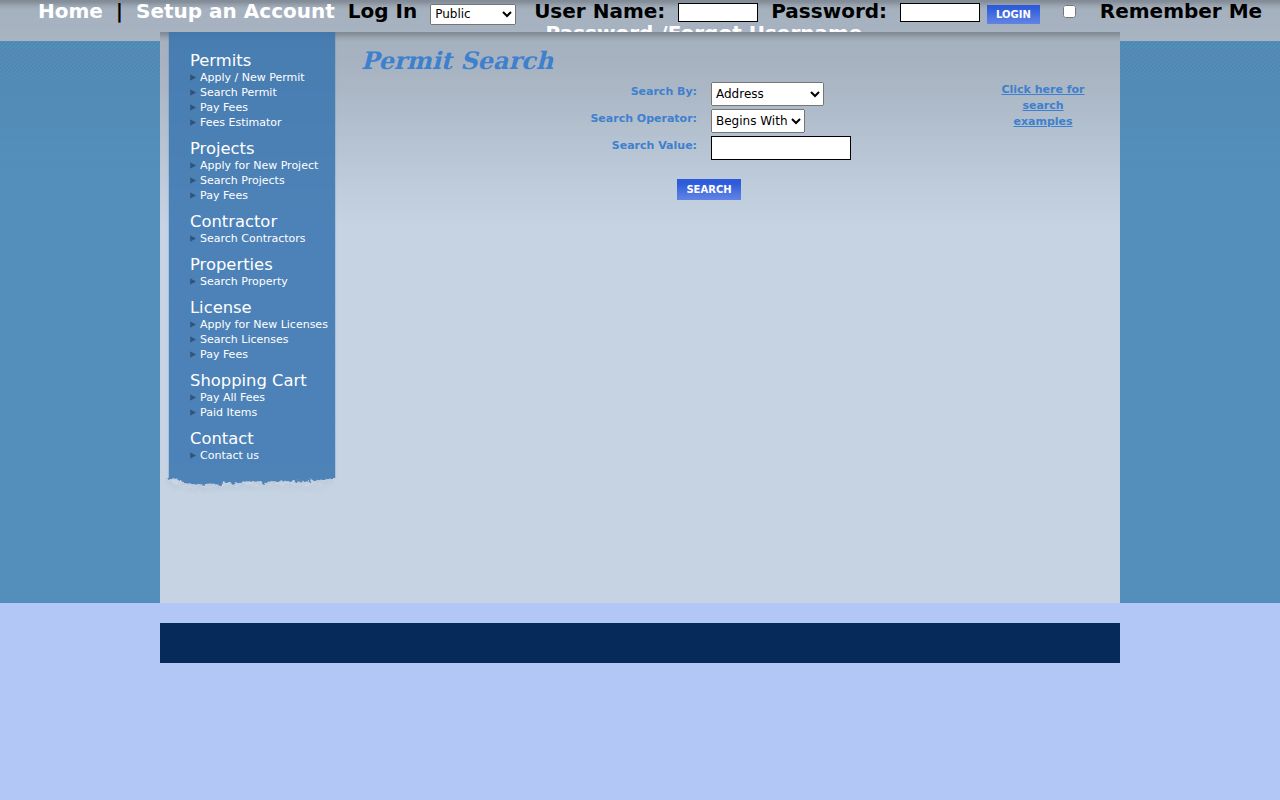
The result tabs separate the site, contacts, fees, reviews, and inspection history, so an address search can reveal more than the permit number alone. Property, contractor, and license searches sit beside permit records. The eTRAKiT license search accepts a company name or license number.
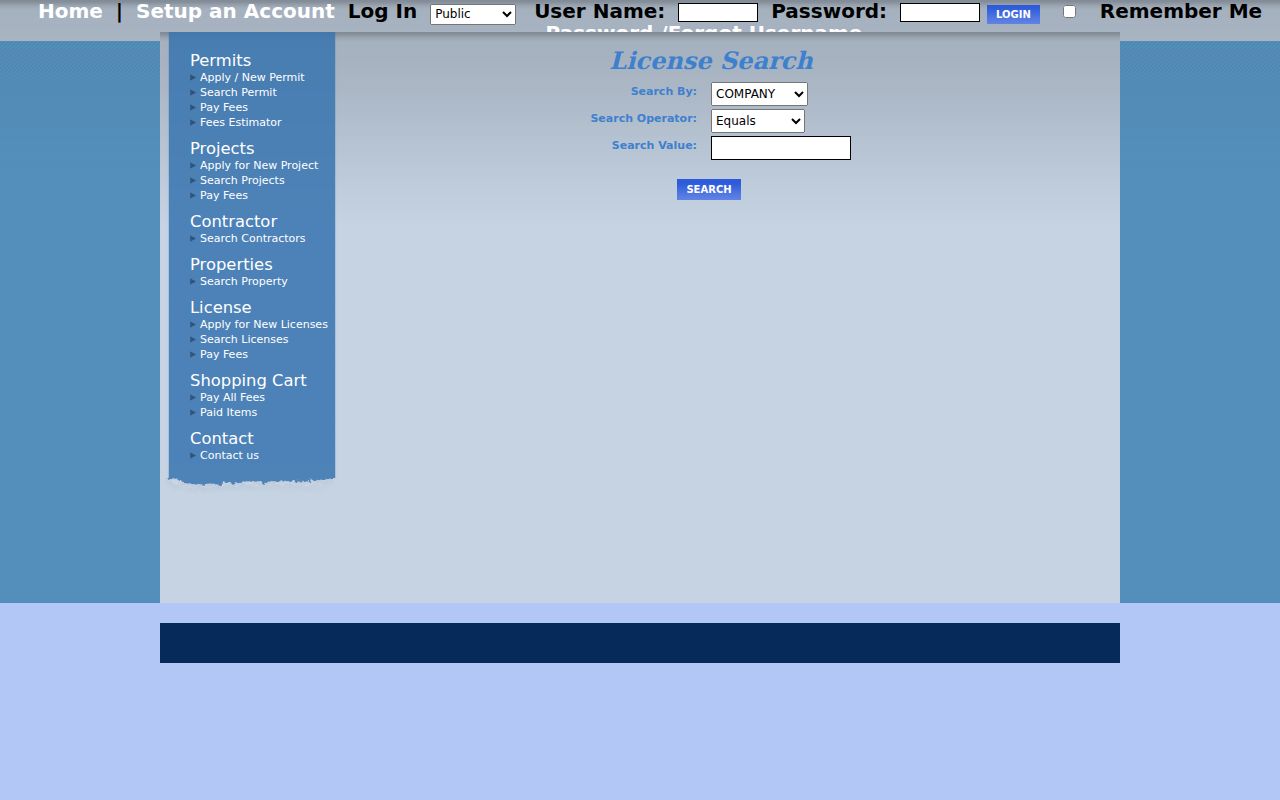
License results can expose site, contact, fee, inspection, chronology, condition, and review categories when those details are public.
South San Francisco Safety Records
South San Francisco Police accepts report-copy requests by mail or in person. Its records unit is open Monday through Friday from 8 a.m. to 5 p.m. and Saturday from 2 p.m. to 6 p.m. Report copies cost 25 cents per page, and traffic accident reports need at least five working days. Citizen RIMS supplies a separate public view of crime mapping, calls for service, recent arrests, and crime and stop statistics.
Citizen RIMS replaced the city's media bulletins on May 28, 2025 and includes data from January 1, 2025 forward. Date, incident, and location filters help narrow the feed. Some incidents remain absent because privacy, victim-confidentiality rules, or other laws bar publication. A missing entry is not proof that no incident exists.
County agency files use their own channel. The San Mateo County Sheriff records request page explains the Sheriff's route.
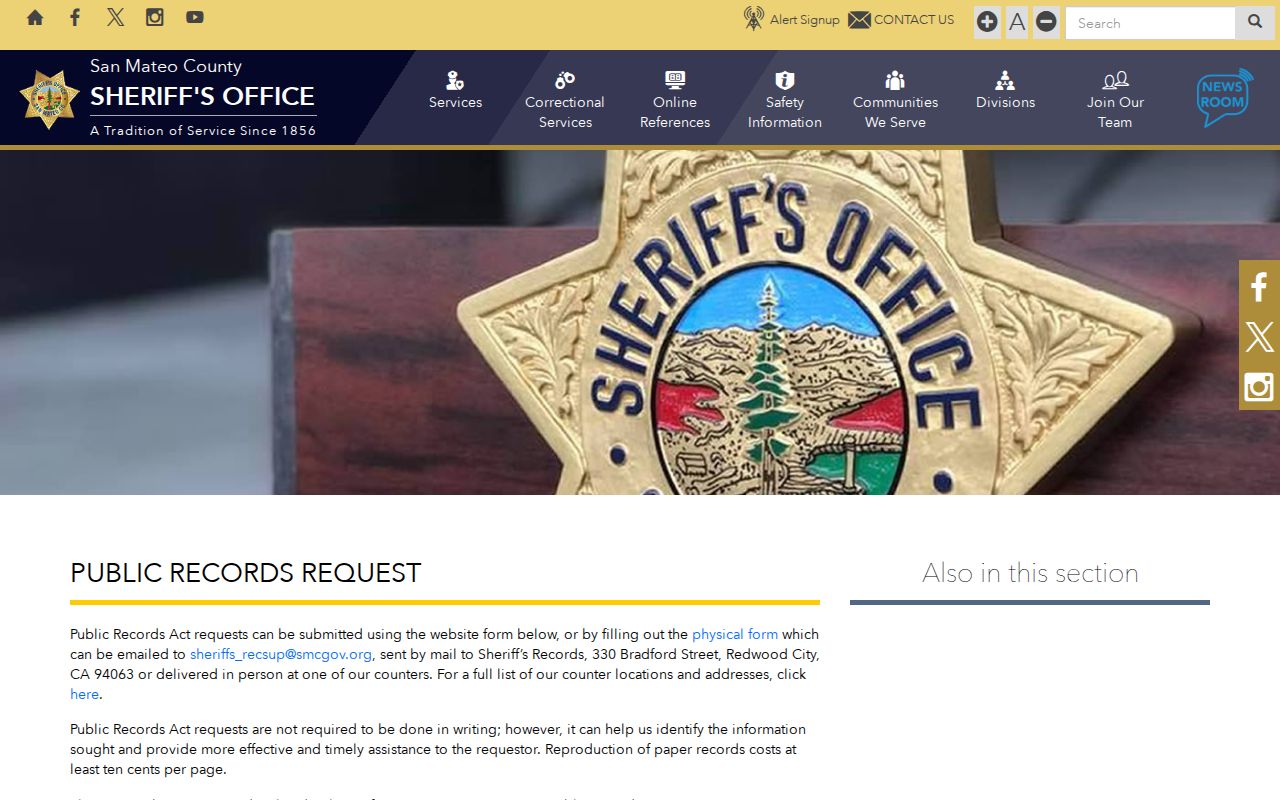
Attorneys, involved parties, and people seeking their own reports are directed to the Sheriff's Request for Information process instead of the general PRA form.
City and County Request Channels
South San Francisco's GovQA center supports new submissions, anonymous submission, account tracking, reference-number search, and a public archive of earlier requests and responsive files. Anonymous filing is useful when account tracking is not needed. The city asks for a clear date range, the department or staff that created the record, and helpful keywords. The South San Francisco GovQA Public Records Center presents those choices on one screen.
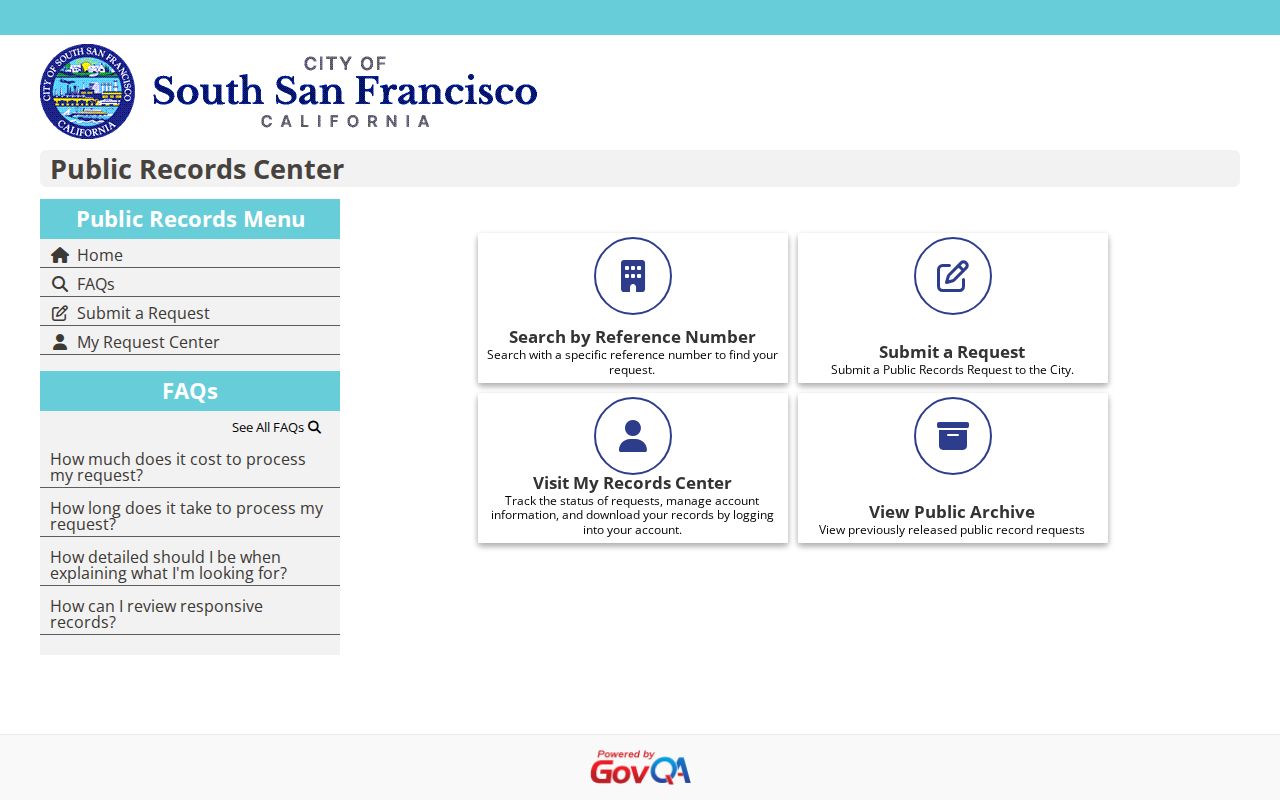
The archive can answer a question before a new filing, while the reference number lets a requester return to a known city request. The City Clerk's public request instructions state that anyone may seek city records without identification or a reason.
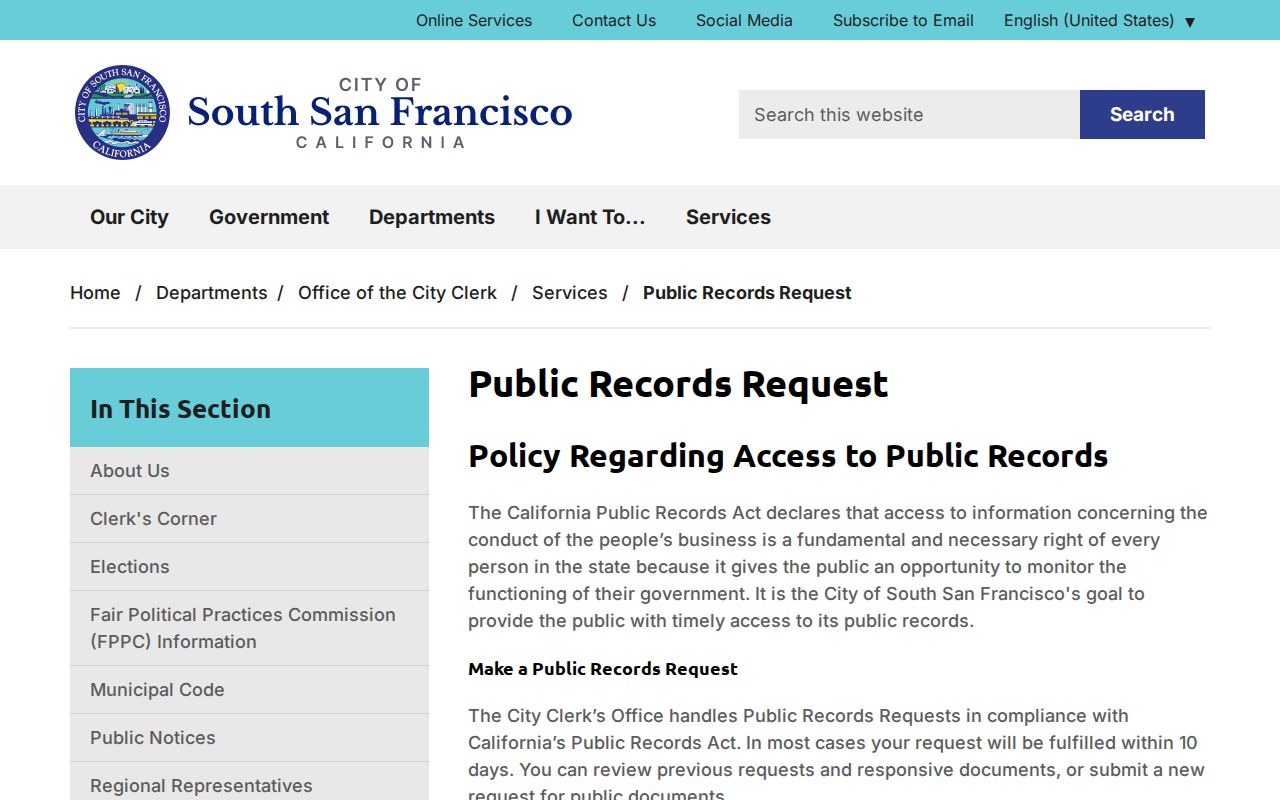
That page joins the legal right of access to the practical GovQA submission and prior-request archive. San Mateo County has a separate route for county departments. Its Public Records Act request form page supplies the county form.
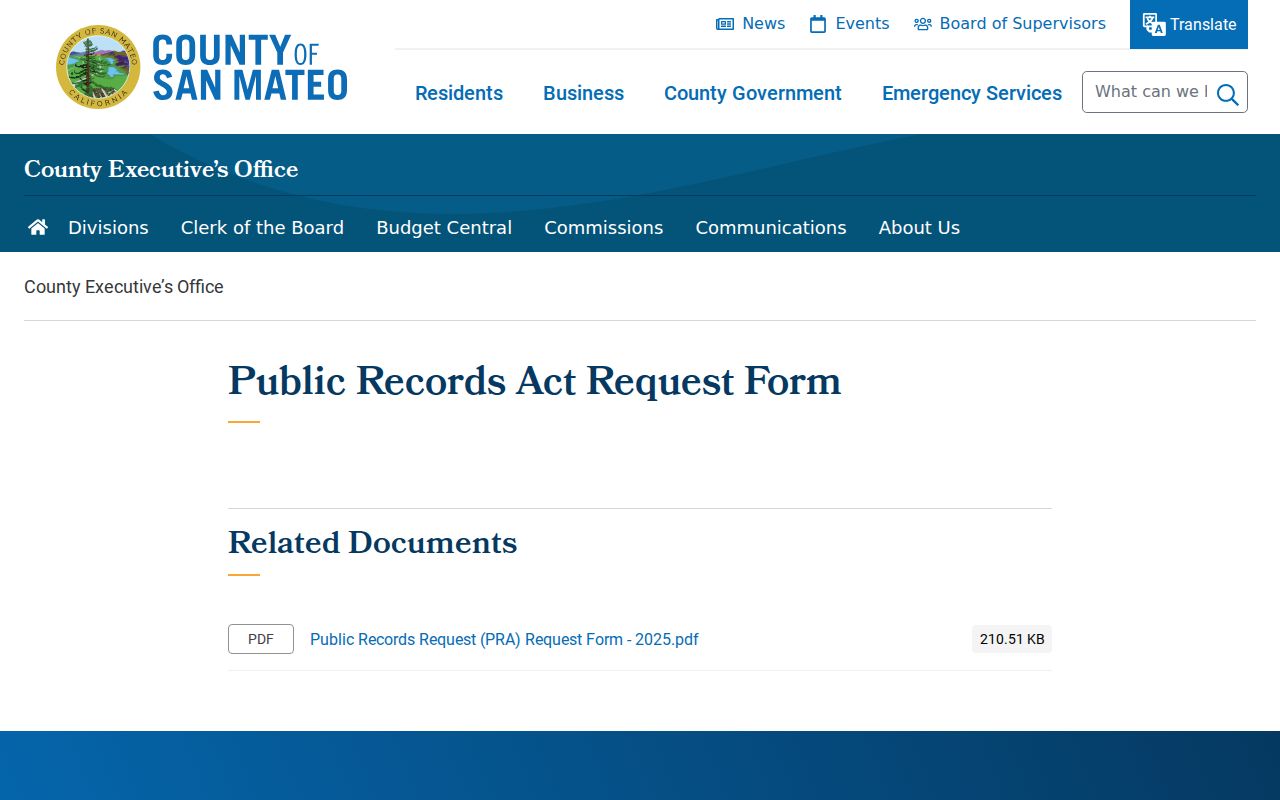
The split matters: city files go to South San Francisco, general county files go to the relevant county department, and Sheriff files follow the Sheriff's process.
Requesting South San Francisco Public Records
The California Public Records Act, Government Code section 7920.000 and following, gives the working framework. An agency must determine within 10 calendar days whether it has disclosable material. Unusual circumstances may add up to 14 days to that determination. Inspection is generally free, and ordinary copy fees are limited to direct duplication costs unless another statute sets the charge.
- Identify the city, county, court, state, or federal custodian that created or keeps the file.
- Check its index or prior-request archive first, but do not assume an index contains the full document.
- Describe the record with dates, names, department, address, document or case number, and a narrow subject.
- Choose the correct form, portal, counter, mail, or email channel and state whether inspection or copies are wanted.
- Review the response, narrow an overbroad request if useful, and challenge a wrongful denial under Government Code sections 7923.000 through 7923.500.
FOIA applies to federal agencies, not California city or county agencies. The California Attorney General cannot fetch another office's records. A request therefore succeeds or fails first on custodian choice. Statutory fees for court, recorder, police, and vital copies can also differ from ordinary duplication charges.
Lawful personal use. Open records may support family history, estate work, civic review, and scam checks; never use a record to stalk, harass, threaten, or harm anyone.
Records Before the Digital Era
The county record trail is much older than its websites. An Online Archive of California finding aid describes San Mateo County Recorder's Office records from 1857 through 1872, including deeds, mortgages, liens, land claims, homesteads, and abandonments. That group is stored off-site at UCLA Library Special Collections and requires advance notice. It reaches back before South San Francisco incorporated and before modern parcel and street systems.
Later records still move offline at key points. RecorderWorks begins its online index in 1985, but older books, fiche, document numbers, and office tools remain relevant. San Mateo marriage records before 1966 require off-site retrieval. Court lobby computers show post-2000 filings and dates that the web may not fully expose. These fallbacks are part of the access system, not signs that no record exists.
Historical land entries may use Baden, old subdivision names, industrial tracts, or the South San Francisco Land and Improvement Company rather than a current street label. A modern APN, legal description, book/page reference, or recorded document number can bridge those eras more reliably than a name-only request.
Note: Bring old place names and current parcel details together when an early South San Francisco deed does not match a modern address.